The fifth essay
The books
The travellers who were hauled up the rocks in nets had mostly come for one thing: the old books the monks kept and could no longer read.
Robert Curzon was a collector, and makes no secret of it. He went from monastery to monastery through Egypt, the Holy Land, Meteora and Athos with gold in his bag, asking to see the library. At Barlaam the abbot showed him about a thousand volumes, most of them printed in Venice, and between one and two hundred manuscripts, all books of divinity. Two he wanted badly: a Bulgarian folio he could not read, and a Gospels with pictures of the eleventh century. The monks would sell neither.
“It was of no use to the monks themselves, who cannot read either Hellenic or ancient Greek; but they consider the books in their library as sacred relics, and preserve them with a certain feeling of awe for their antiquity and incomprehensibility.”
The old abbot, he says, pitched the two books back into the dusty corner he had taken them from, where mice and mildew were actively at work.
Behind the cupboard
At the great monastery the next day the books were harder to find.
“The books are preserved in a range of low-vaulted and secret rooms, very well concealed in a sort of mezzanine: the entrance to them is through a door at the back of a cupboard in an outer chamber.”
There were about two thousand volumes on the shelves and some hundreds of manuscripts, nearly all of them service books. Then the librarian, an old grey-bearded monk, opened a great chest where the things of the church were kept, and in it were ten or twelve Gospels on vellum of the eleventh and twelfth centuries. One was a large quarto, and one of the most beautiful books of its kind, he wrote, that he had met with anywhere. Another was small, written in a very clear hand, and bound in silver filigree as old as the book itself.
In the house, at this hour
The Hall of Wisdom
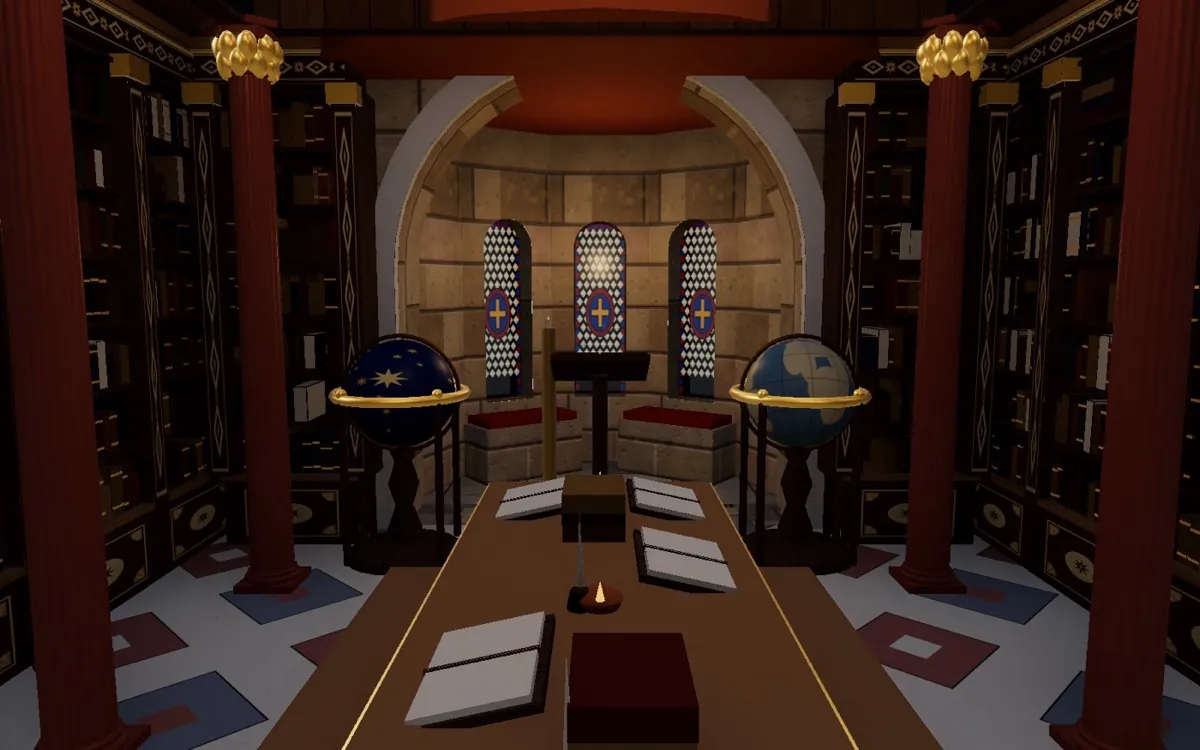
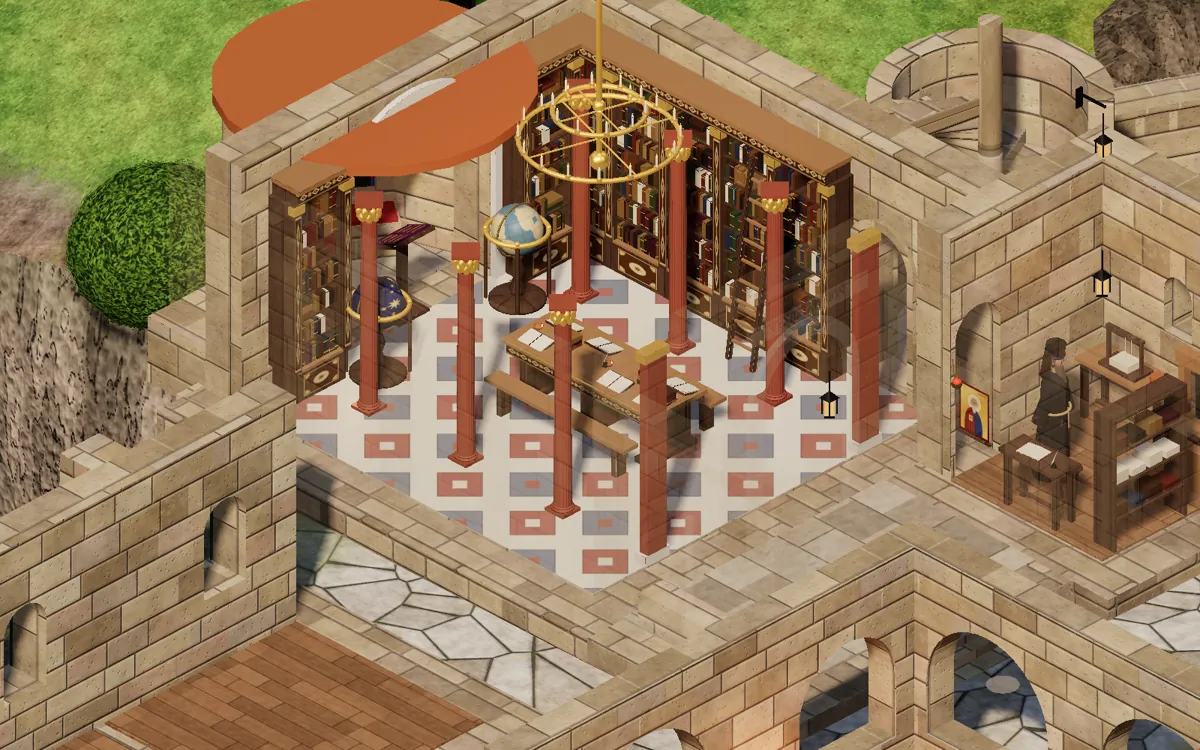
Inlaid walnut cases on every wall, a gallery on six red columns, and the purple Gospel on the great lectern in the oriel over the abyss.
Stand there now ›Sold, and given back
The abbot agreed to sell him the two Gospels. Curzon counted out the gold and packed the books in his bag. He was waiting in the court to be lowered in the net when the librarian demanded half the money. The abbot refused, the librarian told the brethren that the abbot had pocketed the price of their common property, and the whole community fell to quarrelling, “chattering, gesticulating, and wagging their long beards”. At last the abbot said that if he could not keep the money for the use of the house he would have nothing to do with it.
“To my great sorrow I was therefore obliged to receive it back, and to give up the two beautiful manuscripts, which I had already looked upon as the chief ornaments of my library in England.”
The bag was opened and the books taken out. Curzon sat down on a stone in the courtyard and turned the gilded leaves once more, the monks standing round him, looking at “the blue cypress-trees, and green and gold peacocks, and intricate arabesques, so characteristic of the best times of Byzantine art”. Then he laid the great book on the stone, set the little silver one on top of it, and left them there with the sun shining on them.
He thought it a loss all round. The books stayed on the rock.
Where the books are made
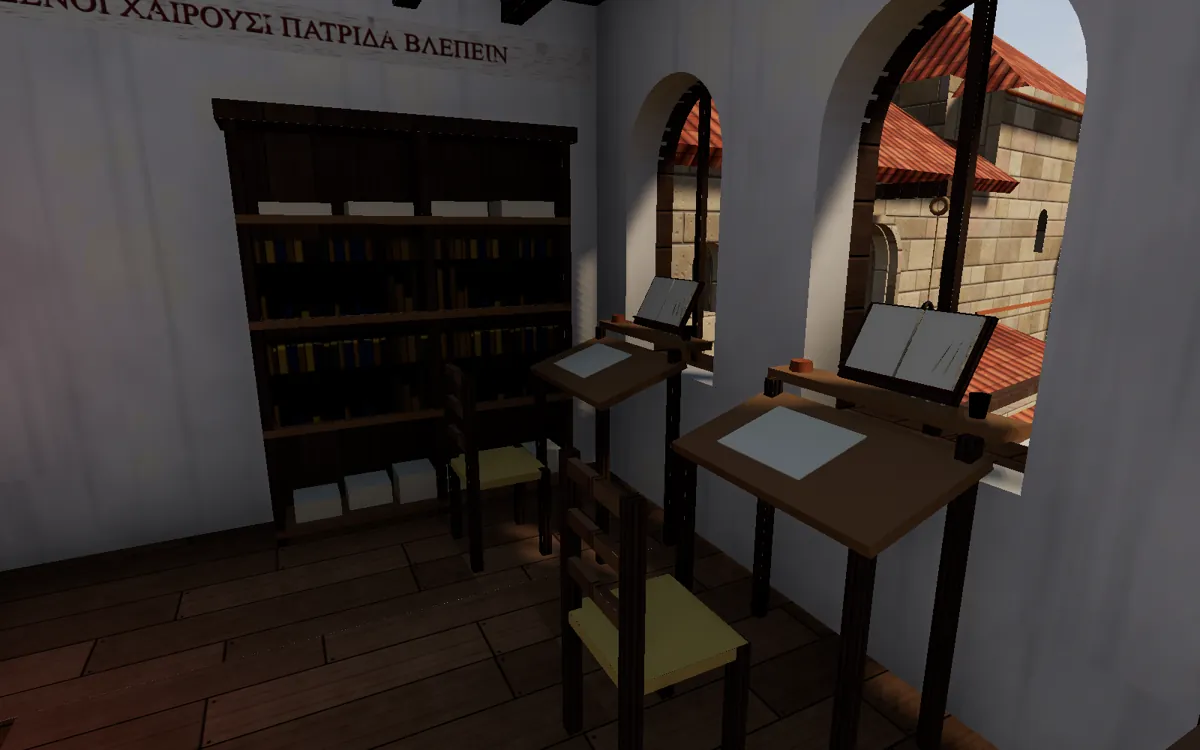
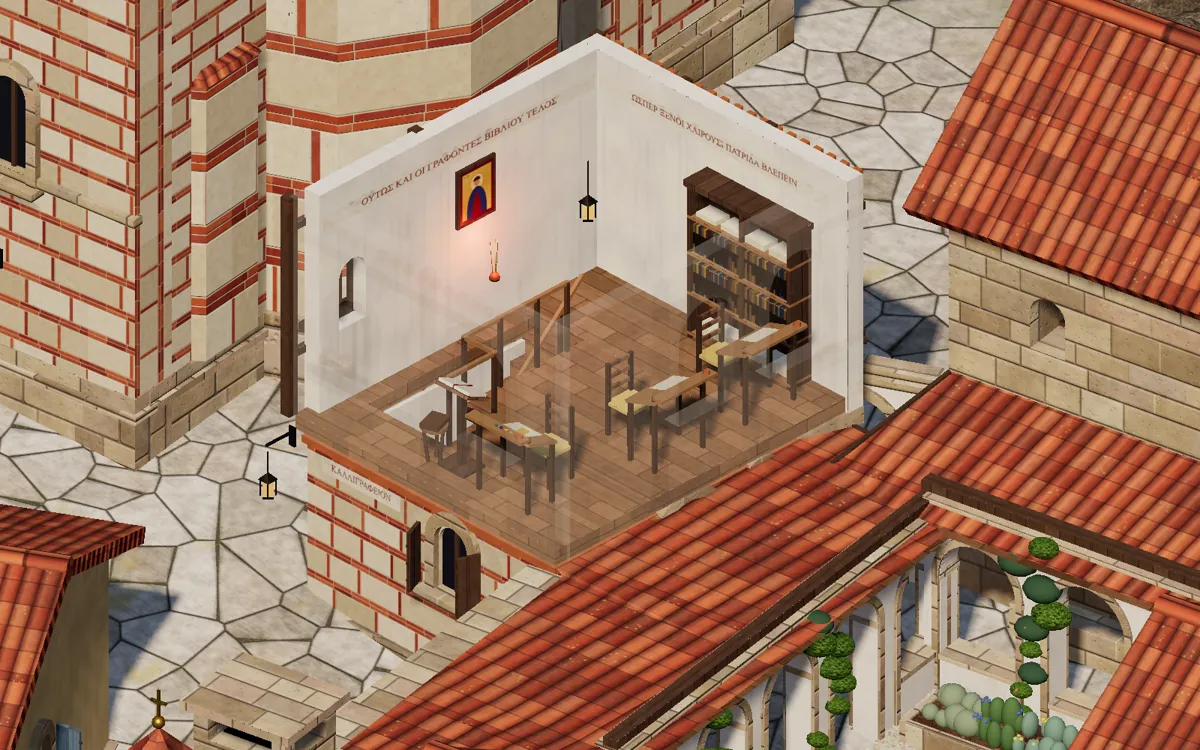
The Sky Monastery still makes its books. Behind the apse of the church stands the scriptorium. On its ground floor the sheets are ruled and the quires hung to dry; in the copying room above, three brethren copy and illuminate under the east windows. The colours they paint with are grown in one of the four beds of the garden cloister next door. Each afternoon the finished books are carried across to the library.
The library stands on the west rim, facing the bell tower across the square. Over its door is written in Greek a place of healing for the soul. Brother Sophronios the librarian keeps it and sleeps in its tower, and at the very top, up a ladder, is the Room of the Ancients, with iron-bound chests and jars of papyri.
The books of this house are not relics. The Rule, the minutes of the council and the book of each office are written by the brethren day by day, and a guest may open any of them and read what the house decided this morning.
In the house, at this hour
The scriptorium
Where the books are made. The finished books go across to the library each afternoon.
Stand there now › Or see where the colours grow ›
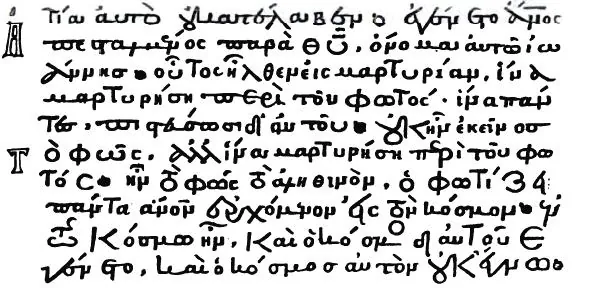
What is invented. The scriptorium, the Hall of Wisdom, its purple Gospel and its librarian belong to the Sky Monastery. The libraries of Barlaam and the great monastery, the hidden rooms and the two Gospels are as Curzon tells them. He is the only witness to his own bargain.
Where this comes from. Robert Curzon, Visits to Monasteries in the Levant (London, 1849), chapter XIX, pp. 290–291, and chapter XX, pp. 303–309, in the public-domain scan at the Internet Archive.
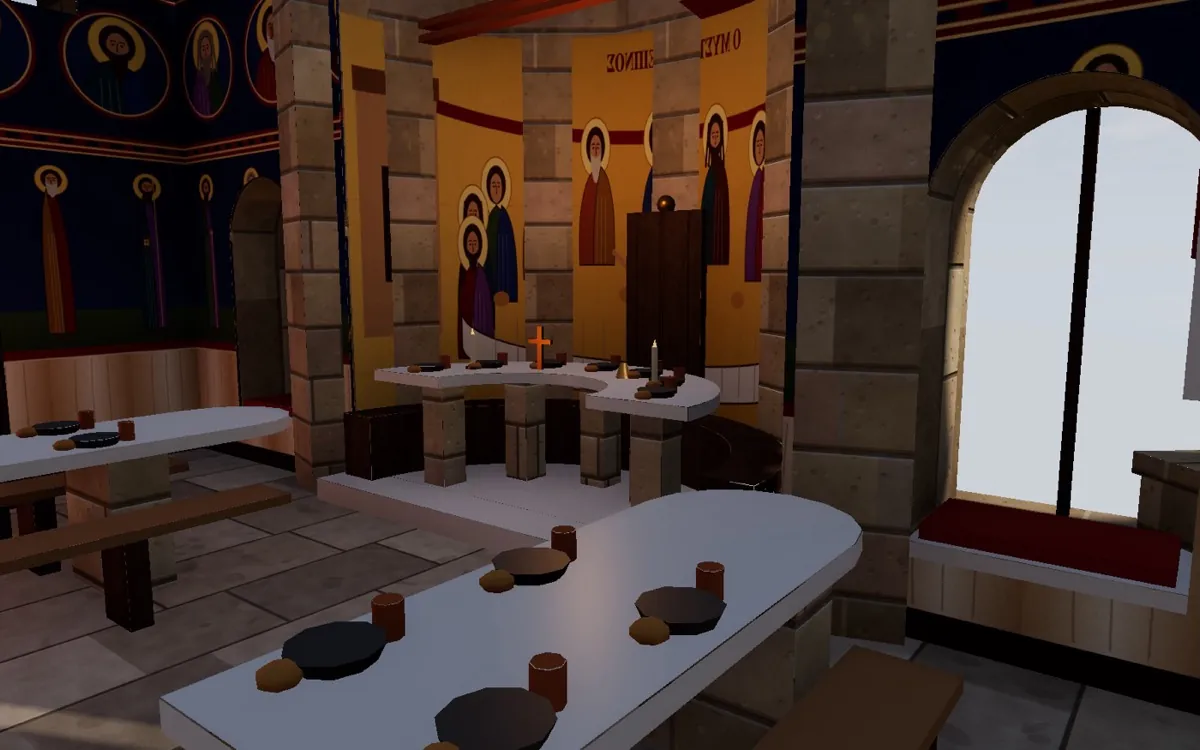 The next essayBread and wine ›A kitchen that is all chimney, a table in an apse, and a barrel the size of a room.